
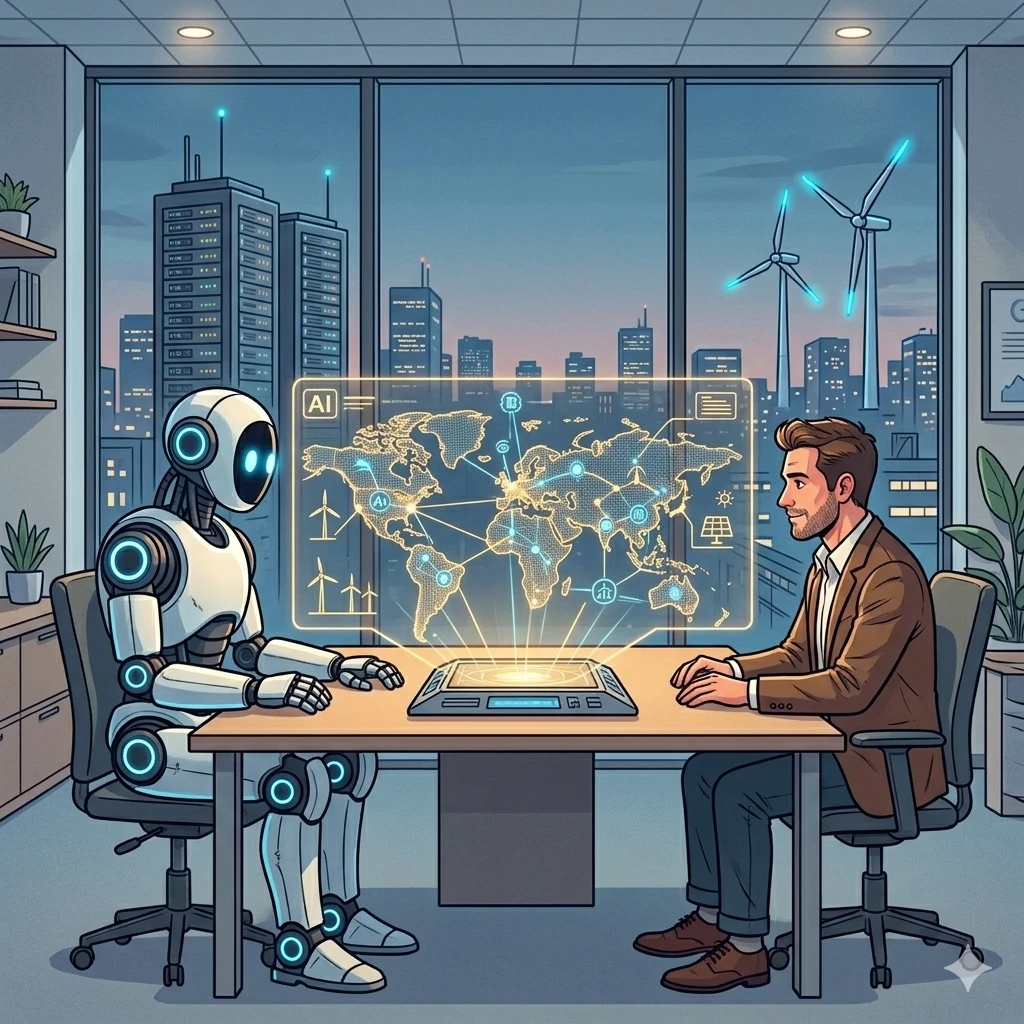
In October 2024 I wrote an article on this site to bring some order to a topic that had become overwhelmingly noisy: Artificial Intelligence. I tried to look beyond the hype and focus on substance — definitions, infrastructure, concrete applications, real costs. I also said I would come back to the subject. It took me 18 months. Not out of laziness, but because so much has happened in the meantime that I never had enough time to keep up — between studying, testing, and early hands-on work.
What I wrote back then still holds at the fundamentals — definitions of AI systems, the distinction between traditional ML and LLMs, the computational resource challenge, the difference between individual and enterprise use. But the landscape has shifted in ways I did not expect, either in speed or direction. Some assumptions that seemed solid have collapsed. Some trends have accelerated almost violently. And some pieces on the geopolitical chessboard that looked fixed have started to move.
Here is what happened — for better and for worse.
1- The end of the scale myth: DeepSeek rewrites the rules
Until recently, the dominant narrative was that AI models — especially generative ones — improved in proportion to their size: more parameters, more GPUs, more data, more compute. The practical consequence was clear: only those with billions to spend on infrastructure could stay in the front row. NVIDIA was (and still is) the new gold, and the US held the new monopoly.
In January 2025, the Chinese company DeepSeek blew up that narrative with a product called R1.
R1 is an open-source model with publicly available, freely downloadable weights — the internal parameters learned during the model training that can be further fine-tuned and determine how the model responds. Across multiple benchmarks it matches GPT-4 and outperforms Google’s latest generation models. What shook the markets was not the performance itself, but how it was achieved: DeepSeek claimed to have used 2,000 NVIDIA GPUs instead of the 16,000+ deployed by OpenAI for comparable models, at an estimated training cost of around $6 million, versus the hundreds of millions spent by American competitors.
How is that possible? Through an architecture called Mixture of Experts (MoE): instead of activating all of a model’s parameters for every query — as traditional “dense” models do — only a specialized subset activates based on the type of problem. More efficient, not simply bigger.
On launch day, NVIDIA lost $600 billion in market capitalization in a matter of hours. Not because DeepSeek defeated them technically, but because the market understood that the story “more compute = better AI” might not last forever. And if it does not last, the expected value of future GPU investments shrinks.
DeepSeek did not solve the efficiency problem — including the energy problem. It shifted it. More efficient models make AI more accessible, which means more usage and more total compute: when a process becomes more efficient, its total resource consumption often grows, not shrinks. But DeepSeek did something equally important: it proved that algorithmic innovation matters as much as infrastructure, and that the American technological monopoly in AI is not guaranteed.
2- Models that “think”: AI slows down to do better
In my 2024 article I described LLMs as systems that generate output from input — probabilistic, fast, sometimes imprecise on complex reasoning. Over the past 18 months, a new family of models has emerged with a different approach: before answering, they reason.
OpenAI launched o1 in December 2024 and o3 in April 2025. These models take more time — and more computational resources — to produce a response, simulating an internal reasoning chain before generating output. The result: on tasks requiring logic, mathematics, complex programming, or multi-step analysis, performance improves significantly — up to 20% fewer major errors compared to previous models on certain benchmarks.
Un aspetto negativo è che il costo per gestire ogni query è più alto, ma per applicazioni professionali dove la qualità della risposta conta davvero — diagnostica, pianificazione industriale, ricerca, analisi legale — o per applicazioni altrettanto critiche come la difesa militare (che avrei preferito non menzionare) il trade-off ha senso.
DeepSeek R1 appartiene anche a questa categoria: è un modello reasoning open source che ottiene risultati comparabili a o1, a una frazione del costo, e ormai tutti i principali provider di servizi AI convergono su questo tipo di applicazioni basate sul ragionamento complesso.
3- Agentic AI: from tool to collaborator — or competitor?
In 2024 I was talking about LLMs as virtual assistants and co-pilots. Today the conversation has moved to something more ambitious: agents.
An AI agent does not just respond — it plans, uses tools, executes sequences of actions autonomously, and self-corrects when something goes wrong. It can search the web, write and run code, fill out forms, send emails, coordinate other agents. All without continuous human intervention.
According to McKinsey (State of AI 2025), 88% of organizations already use AI regularly in at least one business function; 62% report experimenting with or scaling specific agentic AI systems. Gartner estimates that 40% of enterprise applications will incorporate task-specific AI agents by end of 2026, up from less than 5% in 2025. The adoption curve is steep.
What should concern us most is not the risk that agents become sentient, but that they are being introduced too quickly into processes that have not been redesigned to include them, with expectations of autonomy that do not match current actual capabilities. An agent that makes an error in an automated workflow can multiply that error many times over before anyone notices.
Perhaps the right question to ask is not “can I use an AI agent for this?” but rather: “is my process robust enough to tolerate and catch an autonomous error?”
4- Infrastructure: the race has become a geopolitical contest
In 2024 I had already flagged resources as a central issue — GPUs, data centers, energy, environmental impact. In 2025 the topic has grown beyond any reasonable forecast.
In January 2025, Donald Trump announced the Stargate Project: a joint venture between OpenAI, Oracle, SoftBank and Microsoft, with a $500 billion investment plan in AI infrastructure in the United States over the next four years. The current pipeline stands at nearly 7 gigawatts of computational capacity. US data centers consumed 183 TWh in 2024 — roughly 4% of total US national electricity. Projections for 2030 point to 426 TWh, more than double.
The IEA published striking figures in 2025: global data centers consumed approximately 415 TWh in 2024 and are expected to reach around 945 TWh by 2030 — again, more than double. In the US and China, where most AI infrastructure is concentrated, over 60% of this energy still comes from fossil fuels, and the same share is projected to cover much of future growth. A typical AI data center consumes as much electricity as 100,000 households — the largest ones currently under construction, twenty times as much.
In my 2024 article I had already written that “if the energy used were not renewable, a non-negligible environmental impact problem would arise.” At this point, the problem is no longer hypothetical. It is happening.
The other dimension of this race is geopolitical. Stargate is explicitly positioned as a response to China — but DeepSeek itself is the proof, perhaps unintentional but effective, that US export controls on advanced chips to China have not stopped Chinese AI development: they have only made it more creative.
The battle for technological sovereignty in AI has begun, and Europe — Italy included — is for now a spectator more than a protagonist.
5- The regulator woke up: the AI Act is now operational law
In 2024 I cited the European AI Act primarily as a definitional reference. Today it is active enforcement, with precise dates and real penalties.
February 2025: AI practices deemed unacceptable risks are banned — social scoring, behavioral manipulation, mass biometric identification in public spaces.
August 2025: obligations for general-purpose AI (GPAI) models come into force — transparency, documentation, risk management. The EU AI Office becomes operational with real supervisory powers.
August 2026: rules for high-risk AI systems enter into application — covering most industrial, medical, legal, and safety applications.
Fines can reach up to 35 million euros or 7% of global annual turnover.
Italy adds another regulatory layer: in September 2025, Law 132/2025 was approved — the country’s first national AI law, centered on the principles of human-centered AI, transparency, and security.
On the incentive side, the Industria 4.0 and Transizione 5.0 programs — which reward digitalization paired with sustainability — are attempting to create concrete opportunities for companies to invest in AI without losing sight of decarbonization. Opportunities that many have yet to seize.
An overall reading
In 18 months, AI has moved from being an exciting promise to a technology with real consequences — economic, environmental, geopolitical, regulatory. It is no longer a topic to keep an eye on from a distance: it is already embedded in investment decisions, business processes, energy budgets, and industrial policy.
What deserves emphasis — perhaps because it is the most frequently misunderstood point — is that the speed of technological evolution has not been matched by a corresponding growth in adoption maturity. Companies currently implementing AI (and there are many) often do so without redesigning the processes involved, without clear governance, and without plans for managing errors. The technology is ready; the organizations, for the most part, are not. And ironically, AI itself — if used well — could concretely help drive that organizational change.
On the opposite end, those who remain still, waiting for “things to stabilize,” risk discovering that things do not stabilize — they simply evolve, and quickly. Once again, there is no equilibrium point to wait for. The only option is to learn to move while the ground is shifting.
An excerpt of this article was also published in the magazine Dirigenti Industria: Intelligenza Artificiale: 18 mesi di cambiamenti.
A few sources of reference for this article:
- DeepSeek R1 — World Economic Forum
- Stanford HAI su DeepSeek
- The State of AI 2025 — McKinsey
- Gartner: AI Agents in Enterprise 2026
- Energy and AI — IEA
- The Stargate Project — OpenAI
- EU AI Act Implementation Timeline
- AI Act Service Desk — European Commission
